
Skokie Directory Collections by Year
The verified Skokie city directory shelf is a mix of digitized telephone books, address-first volumes, business lists, newspapers, and school publications. It is not one unbroken annual run. The safest approach records the title, edition, page, printed place, and access route for every find. Missing online years should be treated as gaps in the digitized collection, not proof that no directory was issued.
| Collection | Verified years | Where held | Access |
|---|---|---|---|
| Telephone directories | 1924, 1930, 1932-1935, 1937-1938, 1941-1942, 1944-1946, 1948-1953, 1959 | Skokie Historical Society digital collection and library | Free item pages online |
| Haines Chicago Near North Suburban Criss-cross | From 1932, with edition-specific runs | Skokie Public Library catalog | In-library use |
| Dun & Bradstreet Niles Center business listings | 1899-1924 | Library local-history collection | Ask library staff |
| Local school publications | NileHiLite 1939-1980; Niles East, North, and West yearbooks | Library digitized collections | Online or library access |
The research does not establish the first or last year for every printed publisher. Use the years above as collection-specific coverage. For access help, the Skokie Public Library is at 5215 Oakton Street, phone 847-673-7774. Its local-history guide reports public hours of 9 a.m. to 9 p.m., though current hours and licensed database access should be checked before a visit.
Access also changes by format. A digital item page can be opened from home, while a criss-cross volume, licensed newspaper database, or cataloged local file may require an in-person visit. Call with the collection title and year before traveling. If staff supplies a scan or photocopy, ask that the page number and volume title remain visible. Those details let another researcher repeat the search and separate a true gap from a missed index.
Skokie Directories Begin as Niles Center
The village name changed from Niles Center to Skokie in 1940. That change divides the directory trail. A search limited to the modern name can miss the 1938 telephone book, earlier business listings, maps, newspaper notices, and census geography. Search both names, preserve the name printed in the source, and note when the later Skokie label was added as a cross-reference.
Neighboring-community labels also matter. The digitized telephone books include material for Morton Grove, Lincolnwood, Niles, Glenview, Northbrook, and other nearby places. An exchange name or directory section does not by itself prove municipal jurisdiction. Match the printed address to a dated map, a census enumeration district, or a Cook County parcel record before assigning the entry to Skokie.
| 1899-1924 | Niles Center business listings provide organization leads. |
|---|---|
| 1924 | The verified digitized telephone-book run begins. |
| 1932 | Haines criss-cross material supplies address-first searching. |
| 1940 | Niles Center became Skokie, so both names remain essential. |
| 1959 | The last year in the verified digitized telephone run. |
Open Skokie City Directories Online
The Skokie Historical Society publishes a year-by-year telephone directory collection. Item pages preserve the edition date and page image, which makes a citation far stronger than an unsourced transcription. The December 1938 volume has 80 pages, was issued by Illinois Bell and Reuben H. Donnelley, begins classified listings on page 25, and moves into Glenview and Northbrook material near page 67.
The source image below shows the digitized item page and its metadata. Record the item number, page, printed spelling, and access date whenever a listing is used.
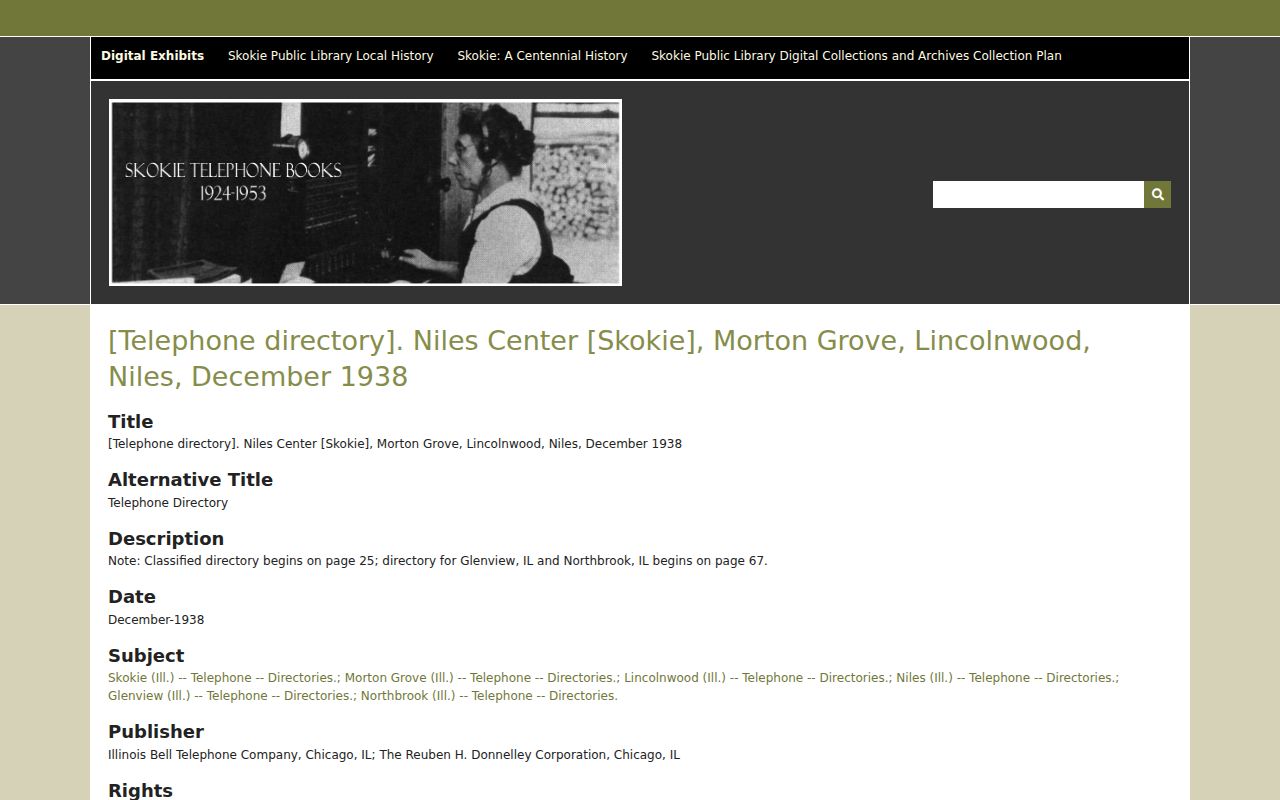
The image confirms where the page scans live and how the item is described. It does not turn a historical listing into a claim about anyone's current address.
Decode a Skokie Directory Entry
A historical line is compact. One documented example reads “Abbink Frank r 4441 Simpson - Niles Center-1022.” It gives a printed name, the residence marker, street address, exchange, and local number. It does not give a spouse, age, occupation, legal owner, or exact move date. Transcribe what appears and resist filling the blanks from assumption.
| Printed name | The person or business exactly as typeset, including initials and spelling. |
|---|---|
| Residence marker | The letter “r” marks a residential listing in this edition. |
| Street address | The number, street, and any printed abbreviation. |
| Exchange and number | A historical phone exchange, sometimes with a suffix, not a modern number. |
| Coverage label | Niles Center or a nearby community as printed in that volume. |
Photograph or save the abbreviation page before interpreting symbols. The meaning can vary by publisher and year.
- Criss-cross directory
- An address-first directory arranged by street and house number instead of surname.
- Householder index
- A name list that may identify the person listed for a household, within the publisher's rules.
- Abbreviation key
- The edition's own legend for marks, shortened words, and listing types.
Skokie Library Expands the Directory
The Skokie Public Library local-history guide connects city directories with family files, churches and synagogues, maps, oral histories, photographs, newspapers, yearbooks, and public-record pointers. Some databases are licensed for in-library use, including Ancestry Library Edition and specialized local newspaper resources. A librarian can also help locate the exact edition and page when a catalog record does not expose a scan.
This collection page is the best first stop when a directory name needs context beyond an address.
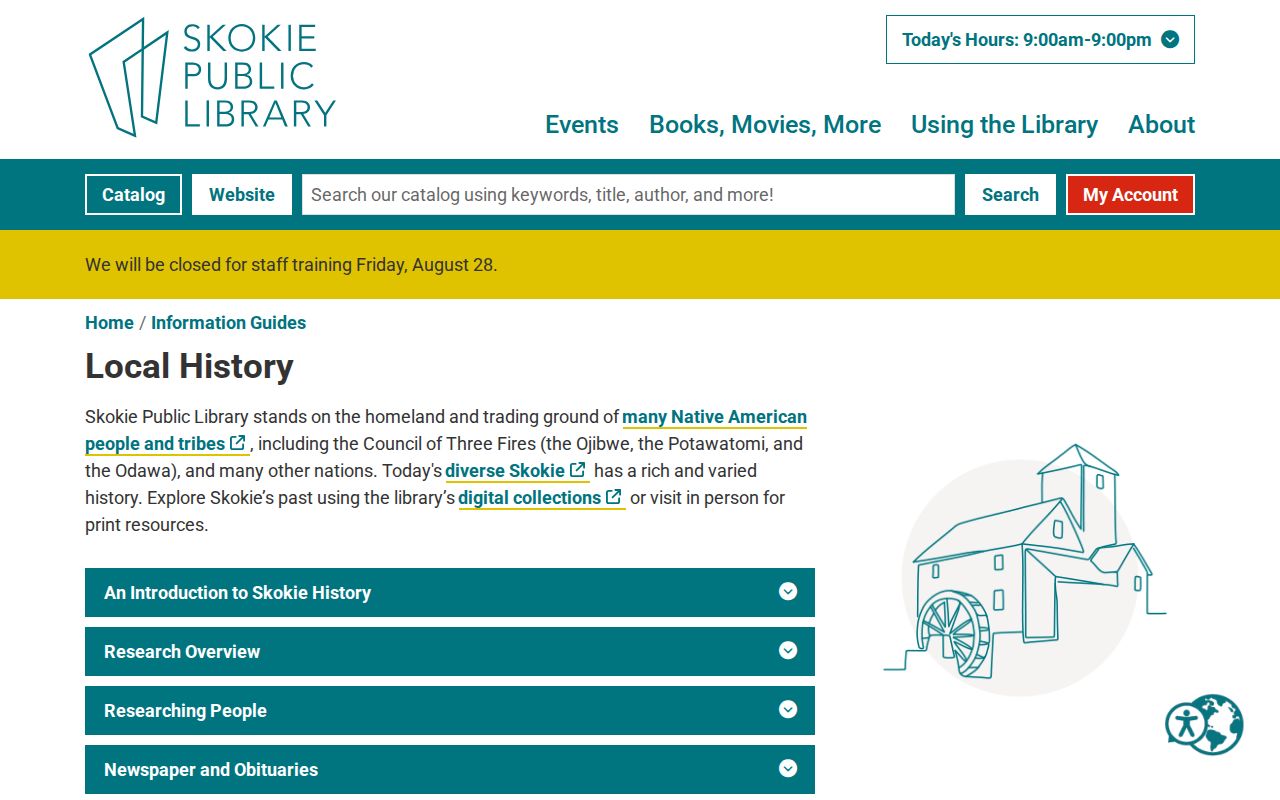
The screenshot shows the institutional route to those companion sources. Access terms can vary, so check the live resource page before relying on remote availability.
Confirm Skokie Names in Print
Directories are snapshots. Skokie's newspaper and school collections can explain what happened between editions. Historical Skokie Newspapers cover the 1930s to the present by title, though much full-page material is available only inside the library. The set includes the Niles Center Herald, Skokie Review, Skokie Life, News, and Villager. The library also points to the German-language Eintracht, Skokie, from 1950-2017 and the Chicago Jewish Post & Opinion from 1962-1981.
The Skokie obituary index covers The News for 1960-1984, Skokie Review from 1981 forward, and the Life Skokie edition from 1978 through October 2004. Preserve the newspaper title and date, then request the actual page. Yearbooks from Niles East, Niles North, and Niles West can confirm a name, class, photograph, club, or school tie on a dated page. None of these sources should be used to infer a current residence.
Search spelling with care. A surname may appear with initials in a telephone listing, a fuller name in a yearbook, and a different transliteration in a community newspaper. Try the printed form first, then a small set of documented variants. Search advertisements and organization names as well as personal names, since a shop, congregation, school, or club may provide the dated link between a person and Skokie.
Place Skokie Listings on Maps
The Skokie Heritage Museum and Historical Society add a physical setting to a city directory line. The museum at 8031 Floral Avenue reports about 22,000 items, free admission, and Tuesday through Thursday hours from noon to 4 p.m. Appointments are requested about a month ahead. Its site joins an 1887 firehouse with the Meyer log cabin, which dates to about 1847 and was moved from 5406 Lincoln Avenue in 1982.
Review the Skokie Heritage Museum collection and visit details before arranging archival work.
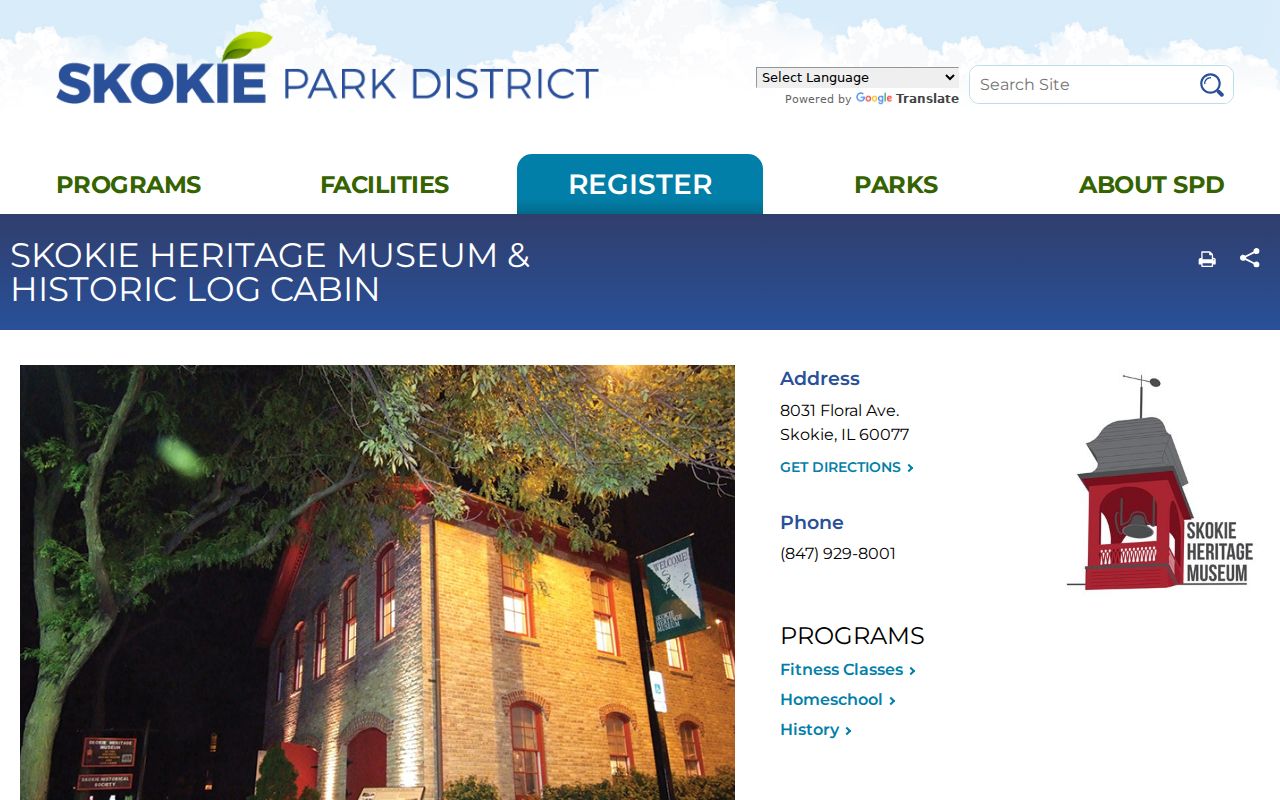
Historical Society exhibits add growth maps from 1888 through 1984. Library of Congress Sanborn sets from 1924 and 1950 show building footprints, construction, roofs, and uses. Those maps can test whether a street address existed in the form printed, but they do not prove who owned or occupied it.
The local map vocabulary can explain changes that look like directory errors. Historical Society stages identify the Western Arm in 1956, 1961, and 1962, the Hockey Stick in 1954 and 1972, and an Evanston disannexation dated November 3, 1965. Cite the map edition and legend with those labels. They are dated growth features, not timeless neighborhood names, and they should not be used without the source map.
Trace Family Through Skokie Directories
A sound family-history trail moves across dates and record types. Keep a research log with the printed name, address, source title, year, page, place label, and image status. That prevents a later Skokie address from being projected backward into a Niles Center source.
- Find the earliest verified listing under both Niles Center and Skokie, including initials and surname variants.
- Check each nearby available edition and note moves, gaps, exchange changes, and the exact printed address.
- Use a criss-cross volume when only an address is known, then compare nearby households.
- Pair the 1930 or 1940 census with the matching directory period, using enumeration-district streets and the federal 72-year release rule.
- Close gaps with a newspaper page, obituary entry, yearbook, Sanborn sheet, parcel record, or certified record from its custodian.
A missing name has several possible causes: the person moved, died, used a variant name, shared a listed phone, was omitted, or fell into a missing edition. One absence proves none of them. Reappearing at the same address in a later volume supports continuity, while an obituary or deed can explain a break.