
How the Skokie Residents Directory Trail Begins
A useful Skokie residents directory search starts with a known name, address, or time period. For a present address, the Cook County Assessor and CookViewer can normalize the parcel and reveal its Property Index Number, or PIN. For a named person, voter status, court, license, business, custody, and unclaimed-property systems each answer a narrower question. For an earlier household, local telephone books, newspapers, maps, yearbooks, and archival records often work better than a current portal.
No official source is a full household roll. Property systems identify owners, not every occupant. The Illinois voter tool verifies one registrant through personal facts but does not publish a public neighborhood list. Directories may omit people who were unlisted, moved between editions, or lived in another person's household. Treat each result as a lead and match names with dates, addresses, relatives, or stable record numbers.
- Enter a known address in the Cook County property tools and save the PIN.
- Use the Illinois voter-status lookup only when you have the registrant's required personal details.
- Search the Cook County Clerk recording index for parties tied to deeds and other instruments.
- Check Skokie Public Library collections for an older name, address, newspaper notice, or directory entry.
- Ask the correct custodian or file an Illinois FOIA request when an identified public record is not online.
Where Skokie Residents Directory Records Are Kept
Jurisdiction is the first filter. Skokie keeps municipal files, permits, local birth and death certificates from 1969 forward, and a catalog of department records. Cook County keeps land recordings, assessment and GIS data, court indexes, custody information, suburban election records, and broader vital records. Illinois agencies maintain voter status, professional licenses, corporations, prisons, registries, and unclaimed property. The former elected Recorder of Deeds stopped operating separately in 2020, so land researchers now use the Cook County Clerk Recordings Division. A detailed address workflow appears in the Skokie street directory.
Cook County Clerk Recordings
118 N. Clark Street, Room 120
Chicago, IL 60602
312-603-5050
Cook County Assessor
118 N. Clark Street, Third Floor
Chicago, IL 60602
312-443-7550
Illinois State Board of Elections
Suburban Cook registration status
Illinois online service
312-814-6440
Skokie Residents Directory Address Keys and PINs
The street address is a starting label, while the 14-digit PIN is the durable link among assessment, GIS, tax, and recording systems. The Assessor address form separates house number, direction, unit, street name, and city. Its other modes accept a PIN or a township and neighborhood, and the advanced page adds partial PINs, address ranges, property class, appeal fields, and PIN ranges. Skokie parcels generally sit in Niles Township, but the user should confirm the returned municipality and parcel rather than assume from a postal label.
The Cook County Assessor address search shows the practical form used to turn a street address into a parcel key.
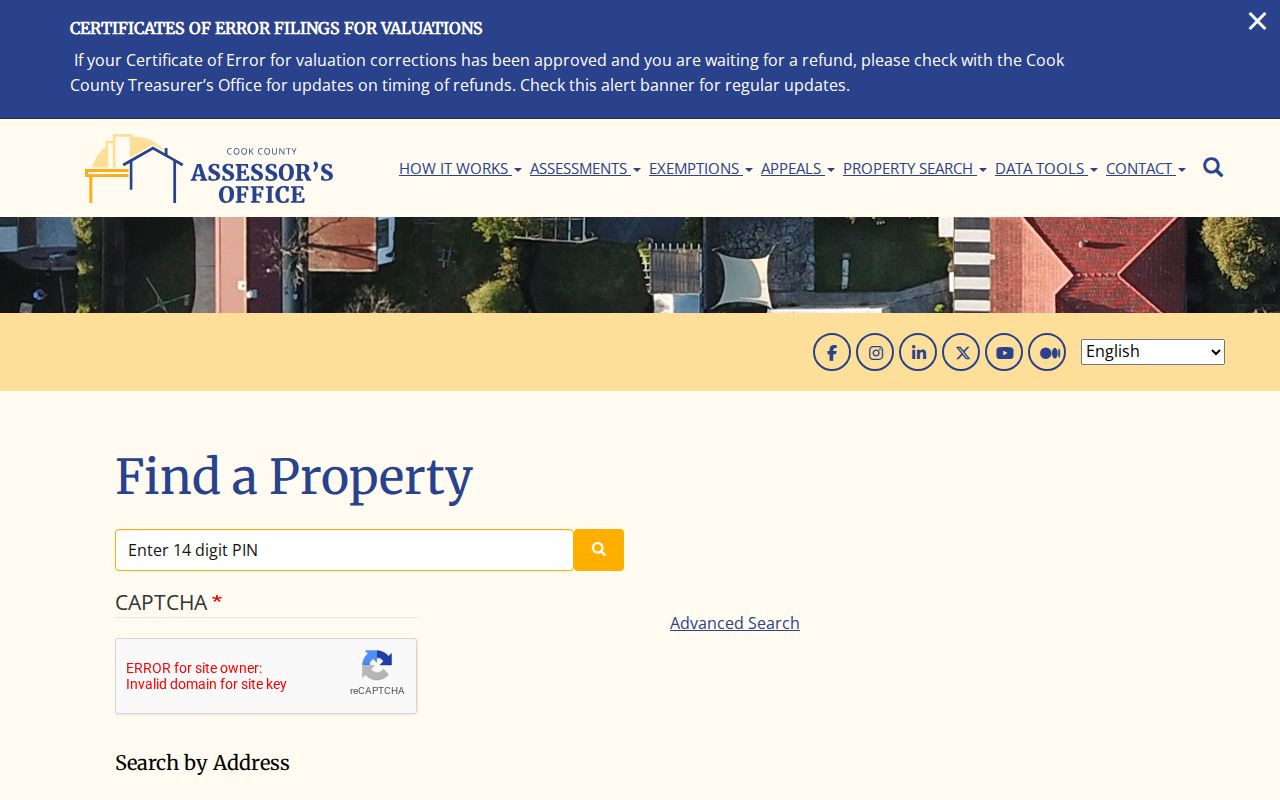
Once the correct PIN is saved, it can be carried into CookViewer, the tax portal, and recording searches without relying on spelling or street-format variations.
| Search path | Fields that matter | Best use |
|---|---|---|
| Address | House number, direction, unit, street, city | Find one known parcel |
| PIN | Fourteen-digit parcel number | Confirm an exact property |
| Neighborhood | Township, neighborhood, property class | Compare a local group of parcels |
| Advanced | Partial PIN, address range, appeal details | Broaden a failed exact search |
The Skokie Residents Directory Before 1940
Historical searching has a local trap: Skokie was called Niles Center until the village adopted the Skokie name in 1940. A family or property may therefore appear under different place labels without moving. Early records can also follow township, postal, school, or county geography instead of today's village boundary. Search both names, keep the year in view, and use maps or plats to decide whether two references point to the same place.
Local search tip. Pair “Niles Center” with the surname or street when a Skokie search fails for records dated before 1940.
This name shift is one reason the Skokie residents directory cannot be reduced to a single query. A directory entry, census line, map sheet, and deed may each describe the same household through a different geographic vocabulary.
Current Skokie Residents Directory Sources
Modern directory-like sources are purpose-built indexes. They do not claim to list every resident, and access varies by record. Property tools are open by parcel or address; voter status requires identity details; the recording portal searches named parties; court and custody systems cover only people connected to those records. The village business and resource directory lists organizations rather than households. Choose the source whose reason for collecting a name matches the question.
| Source | Who It Lists | Keeper | Access |
|---|---|---|---|
| Assessor and tax property files | Owners and parcel facts | Cook County | Free online search |
| Voter status lookup | One registered voter | Illinois elections system | Identity-based query |
| Recorded-instrument index | Grantors, grantees, and document parties | Cook County Clerk | Public search portal |
| Business and resource directory | Listed firms and organizations | Village of Skokie | Free A-Z and category search |
| Professional license lookup | Licensed people and regulated entities | Illinois IDFPR | Daily single search |
For one person, begin with a source tied to a known fact, then compare an address, middle initial, date, relative, case number, or license detail. The Skokie resident lookup explains that identity-matching process without treating a same-name result as proof.
Voter Status in the Skokie Residents Directory Trail
Illinois provides a public registration-status form, not a downloadable list of Skokie voters. The first stage asks for first name, last name, date of birth, and five-digit ZIP. After the ZIP validates, the form asks for street number and a street name chosen from a ZIP-dependent list. This design helps a person confirm a registration but does not support browsing everyone on a block.
The Illinois voter-status lookup illustrates why the correct ZIP and exact identity details matter.
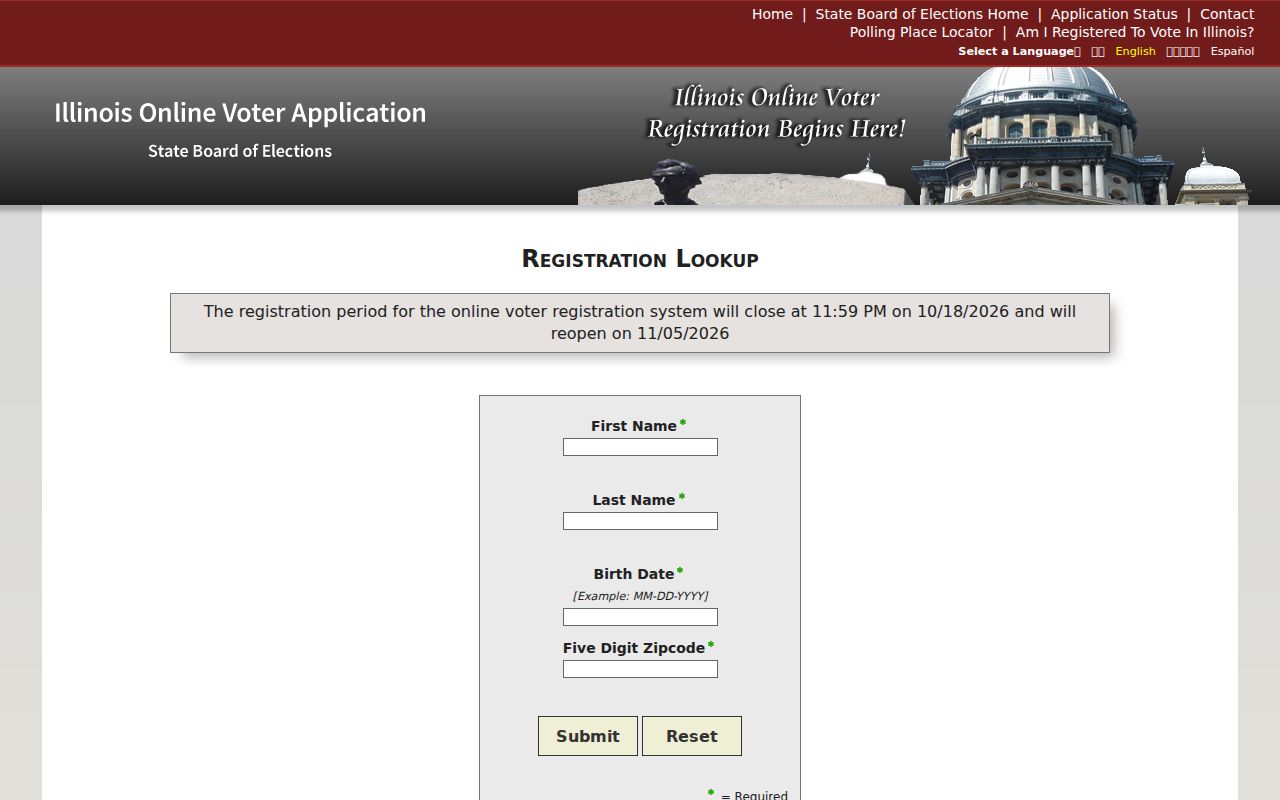
Broader computerized voter data follows separate Illinois rules and is limited to eligible recipients and purposes. The public-facing Skokie residents directory workflow should stay with individual status verification.
Skokie Residents Directory Court and Custody Clues
Cook County's Odyssey portal searches case numbers or names and offers filters for party, attorney, case type, status, filing dates, and other fields. Results may show a case number, caption, filed date, type, status, and hearings, but the online docket is not the official court file and may lag. The Skokie Courthouse serves the Second Municipal District, while the countywide portal reaches more than cases filed at that building.
Custody searches are narrower. The Cook County locator requires a full first and last name or booking ID plus reCAPTCHA. Illinois Department of Corrections accepts a last name, IDOC number, or birth date. Federal custody uses the Bureau of Prisons locator. A match shows contact with one system, not a complete biography, so verify identifiers and read the portal's scope statement.
The Illinois State Police registry entry makes users acknowledge its scope, accuracy, and anti-harassment conditions before searching.
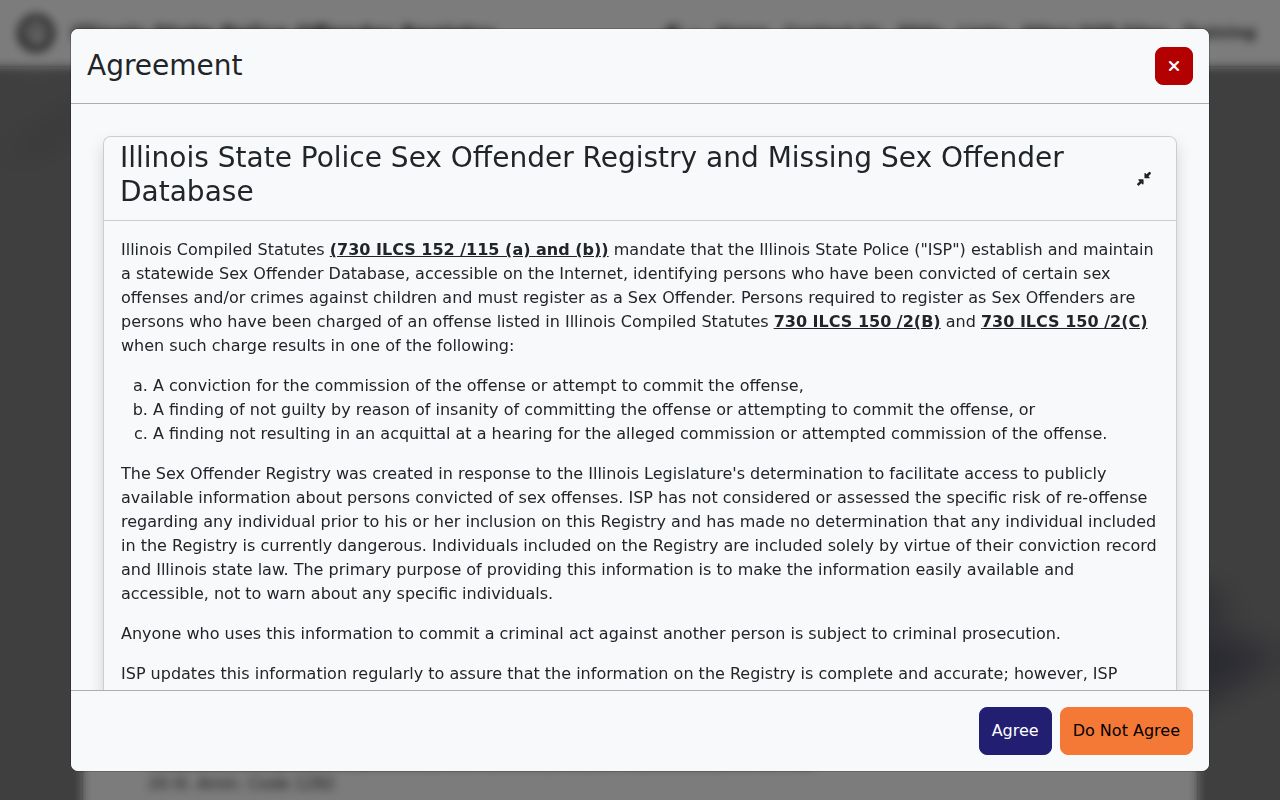
The registry covers defined statutory programs and is not a complete criminal-history index. Its warning reinforces the need to verify a record and avoid misuse.
Vital Events and the Skokie Residents Directory
Village of Skokie Health and Human Services issues qualifying birth and death certificates for events in Skokie from 1969 forward. A local birth copy costs $10 for the first and $5 for each added copy, and access is limited to a listed parent or the adult subject. A death copy costs $12 for the first and $7 for each added copy; the requester must be a legal relative or show a financial interest. The local page allows online, mail, and office routes, with stated processing of up to seven business days.
Cook County offers broader coverage and a Skokie satellite office at 5600 W. Old Orchard Road, Room 149. Its genealogy copies are non-certified and use age windows of more than 75 years for births, 20 years for deaths, and 50 years for marriages. Those limits make vital records useful for a known family event, but not as an open resident-name directory.
Skokie Residents Directory Gaps and FOIA
The Village catalog identifies record series in Community Development, Finance, Fire, Police, Health, the Village Manager's office, and boards. When a known public record is not posted, the Illinois Freedom of Information Act, 5 ILCS 140, provides a request route. Skokie accepts requests through its online portal, by PDF, mail, in person, or email. A request should describe the record, date range, department, address, permit number, or other useful identifier instead of asking the village to conduct broad personal research.
The standard response period is five business days, subject to lawful extensions and exemptions. The first 50 black-and-white letter or legal pages are free, then the village charges 15 cents per page; color and oversized copies may be charged at actual cost. Private facts may be withheld or redacted under the statute, and specialized records can follow stricter access laws.
A focused request is easier for staff to locate and easier for the requester to assess. Ask for an existing permit file, board record, incident category, map, or dated correspondence, and state whether an electronic copy will work. The custodian may clarify scope, extend the response when the Act permits, or explain an exemption. A denial can be reviewed through the Illinois Attorney General's Public Access Counselor process.
Historical Skokie Residents Directory Collections
Skokie Public Library is the main local-history gateway for newspapers, telephone books, maps, photographs, oral histories, school yearbooks, and research guidance. The Skokie Historical Society has digitized telephone directories for 1928 and 1938 through 1990, though the run has gaps. Its December 1938 volume has 72 pages and was published by Illinois Bell for Niles Center, Morton Grove, Niles, and Lincolnwood. Searchers should inspect the actual volume because coverage and abbreviations differ by year.
The Heritage Museum holds more than 7,000 photographs, books, maps, artifacts, and archival materials, with research visits available by appointment. Illinois Digital Archives adds local images and documents, while Library of Congress Sanborn sets from 1924 and 1950 help place buildings and addresses in time. A full shelf guide and entry-reading method appears in the historical Skokie city directory collection.
A 1938 Skokie Directory Entry Preserves More Than a Name
A digitized directory item can preserve a printed person or business name, a residence mark, street address, telephone exchange and number, and suffix. Those fields are historical claims from that edition, not proof of a current resident. Read the abbreviation key, check whether the volume covers Skokie under its older name, and compare the address against a map or a nearby edition.
The Skokie Historical Society's 1938 telephone directory item demonstrates the metadata and scanned-volume route used for this work.
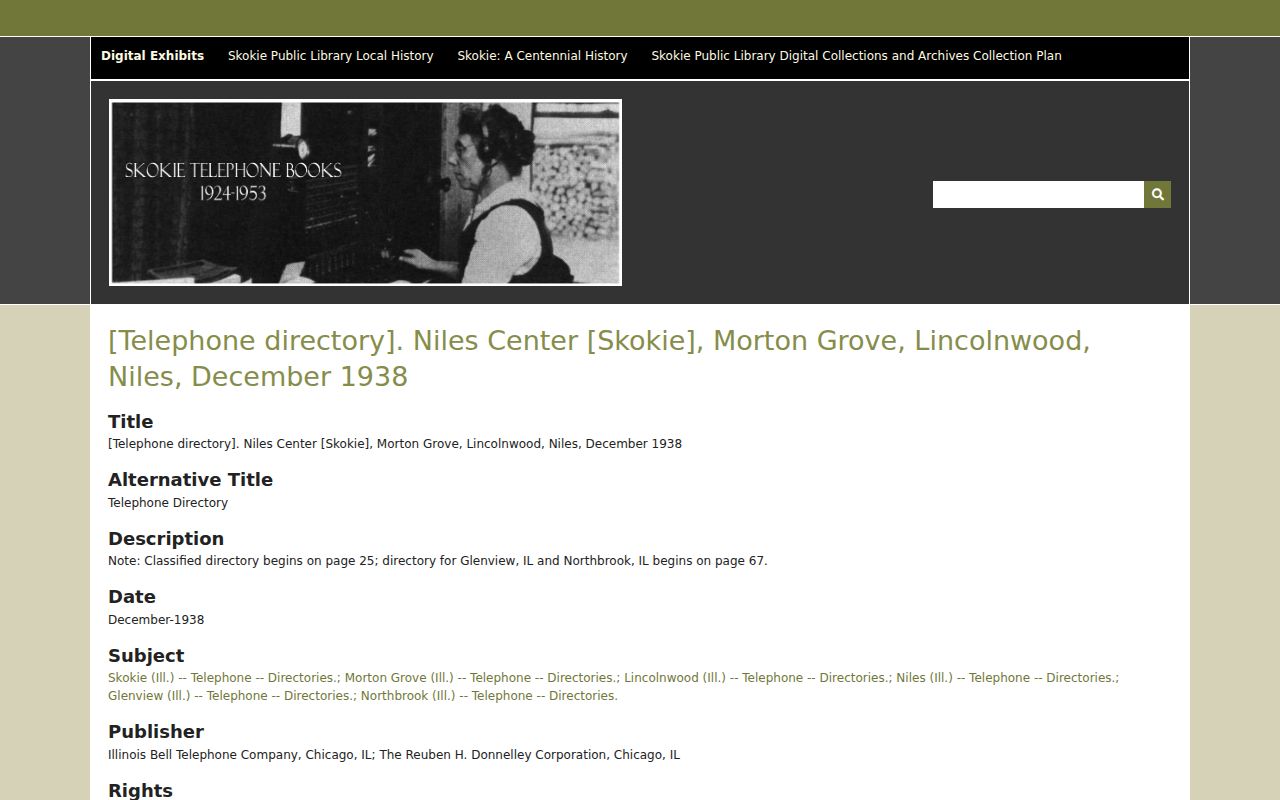
The scan is most useful when paired with an adjacent year, a census schedule, or a property record so that a spelling or address is not interpreted in isolation.
Privacy Boundaries Around a Skokie Residents Directory Search
Public indexes have limits by design. Illinois vital records restrict certified copies, voter files follow eligibility rules, court portals can omit protected material, and FOIA permits privacy redactions. The Illinois Attorney General's Address Confidentiality Program gives qualifying survivors of domestic violence, sexual assault, human trafficking, and stalking a substitute address and separate voter-registration process. Recorded documents also have a statutory route for redacting specified identifiers from online display.
Lawful personal use. Use resident records for genealogy, civic research, reconnecting, estate work, and consumer safety, never to stalk, harass, or harm anyone.
Commercial search tools may merge public and purchased data, charge for access, and repeat stale or mismatched facts. Official custodians are narrower, but they explain the record's purpose and can supply a certified or corrected copy when one exists. Confirm important facts at the source.